
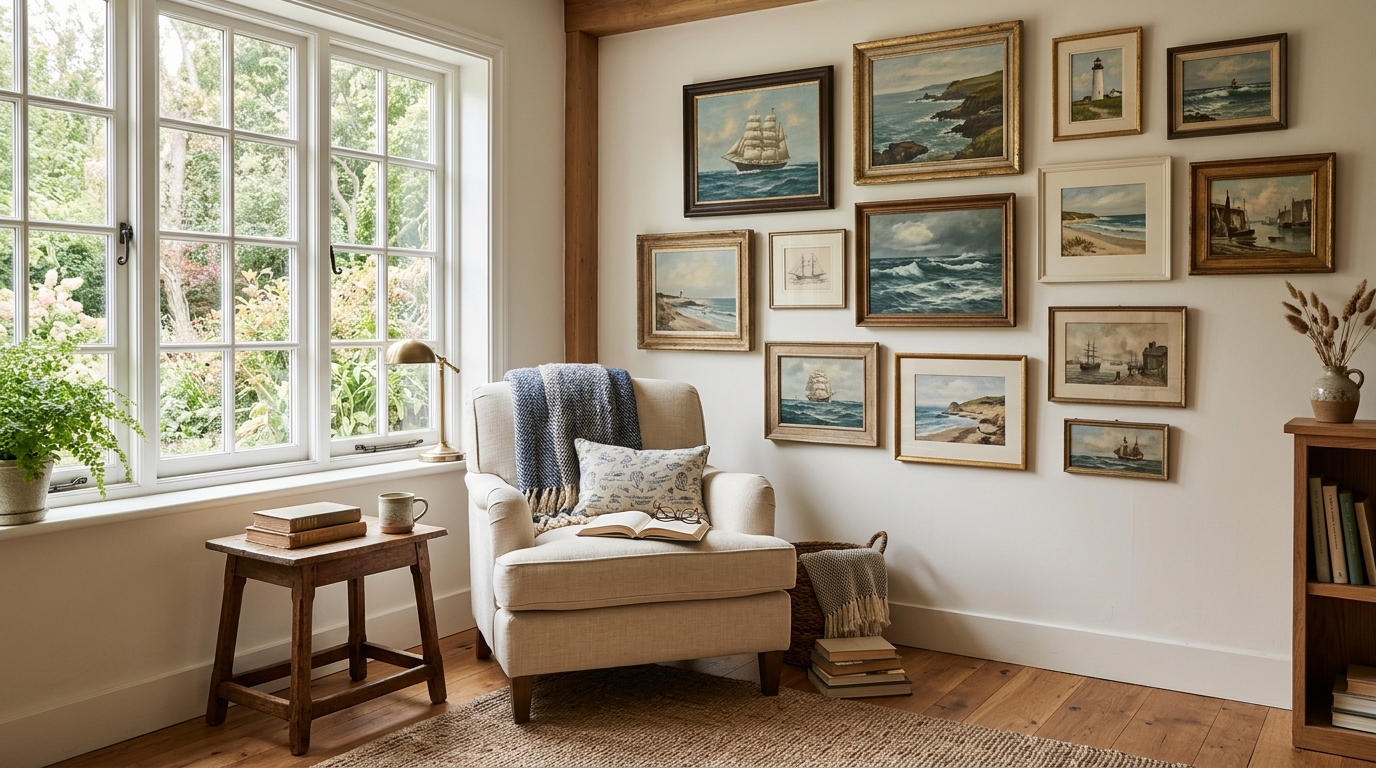
Gallery Wall Art That Tells Your Coastal Story
Last updated November 21, 2026
Gallery wall art works best when it tells a cohesive story rather than simply filling space. Choose a unifying theme such as coastal memories or harbour scenes, select limited-edition prints with Certificates of Authenticity, mix formats intentionally, and arrange pieces so each contributes to a meaningful narrative that reflects your connection to the coast and Canadian landscape tradition.
Table of contents
Choose a Narrative Theme Over Decorative Filler
A meaningful gallery wall begins with a story you want to tell, not a colour scheme or a desire to cover blank space. Coastal memories, harbour scenes and maritime moments create a cohesive narrative that feels personal and grounded in place. The wall becomes a visual record of your connection to the water: childhood summers at the cottage, walks along the harbour at dawn, the quiet feeling you want a room to hold.
The Group of Seven heritage offers a grounding philosophy for selecting Canadian coastal and harbour scenes that honour landscape tradition. Elizabeth A. Evans was mentored by Arthur Lismer of the Group of Seven at the Montreal Museum of Fine Arts, and her work carries that lineage forward in calm fishing villages and remembered coastlines. That heritage matters when you're curating a wall that reflects Canadian identity and connection to place.
Ask yourself what the wall should remind you of: a childhood cottage, a favourite harbour, the feeling of standing beside the ocean at dawn. Those questions guide better choices than browsing by colour or size. If three pieces remind you of the same coastline and two others feel unrelated, the coastal trio builds a stronger narrative. The wall should feel like a chapter from your life, not a catalogue page.
Moments of Calm: Claim the free Maritime Seascapes bookmark and join the studio newsletter for quiet inspiration as you build your collection, one meaningful piece at a time.
Theme also determines what you say no to. A wall about peaceful harbours doesn't need a dramatic storm scene, even if the painting is beautiful. Coherence comes from restraint. According to the Americanart, thematic consistency creates stronger emotional resonance than decorative variety.
Select Limited-Edition Prints and Original Art
Start with works that carry provenance and long-term value. Limited-edition canvas prints provide a professional gallery feel when each includes a signed Certificate of Authenticity. This document verifies edition size and turns a print into a collectible rather than mass-produced coastal wall decor.
Anchor your gallery wall with one piece from the collection of original maritime paintings as the centre focal point, then surround it with coordinating prints. Combining originals with prints allows you to build a maritime art collection over time without the budget pressure of acquiring only one-of-a-kind works. The original holds the emotional centre. The prints extend the story outward.
Choose works painted from memory rather than photographs for a sense of timelessness and emotional resonance. Paintings built from remembered moments carry a different quality than those copied from a snapshot: the artist selects what mattered and leaves out the rest. That selective memory is what makes a coastal scene feel universal rather than documentary.
Elizabeth A. Evans paints from memory in her Gibsons studio on the Sunshine Coast of British Columbia, creating works that capture the feeling of a place rather than its exact geography. Known as the Painter of Special Moments, she builds each canvas from remembered harbours and quiet inlets that carry emotional weight beyond visual accuracy.
Mix Formats for Visual Rhythm
A successful nautical gallery wall integrates different formats: canvas prints, fine art posters and art cards in varying sizes. Avoid uniform sizing. Instead, pair one large focal piece with medium and small supporting works to create movement across the wall. The eye travels from anchor to accent, pausing at each piece rather than scanning a grid.
Frame consistency matters more than size uniformity: choose wood tones or neutral frames that echo a Canadian aesthetic rather than mismatched ornate styles. Light natural wood, soft grey or cream frames allow the harbour scenes and coastal colours to lead, and they work across different formats without competing for attention. Mixing ornate gold, rustic barn wood and sleek black frames on the same wall makes the framing the focal point, not the art.
Use coastal art cards as small-scale pieces within a larger gallery arrangement, filling gaps and adding textural variety. A large harbour scene paired with a small art card of a single boat creates dialogue between the pieces. These cards work particularly well in tight spaces between larger works or as visual punctuation in lower corners.
Start small: Coastal art cards offer a gentle way to fill smaller gaps in your layout while maintaining the narrative and visual rhythm of the larger works.
The mix of formats also lets you add to the wall over time. Start with the anchor original and two supporting prints, live with that arrangement for a season, then add smaller pieces as you find them. Each addition deepens the story without requiring a complete redesign.
Plan Spatial Arrangement for Viewing Distance
Give the wall enough room to be seen as a whole. Arrange the pieces so viewers can stand a comfortable distance back and take in the calm harbour scenes and coastal vistas together.
Up close, each piece rewards a slower look at the boats, the water and the light. From across the room, the arrangement gathers into one story: a fishing village at dusk beside a quiet inlet at dawn. This viewing distance matters when planning furniture placement and wall location.
Hang the visual centre of your gallery wall at 57 to 60 inches from the floor, which aligns with average eye level in a standing or seated room. If the wall is viewed primarily from a sofa or reading chair, lower the centre point by three to six inches so the arrangement feels connected to the sightline rather than floating above it.
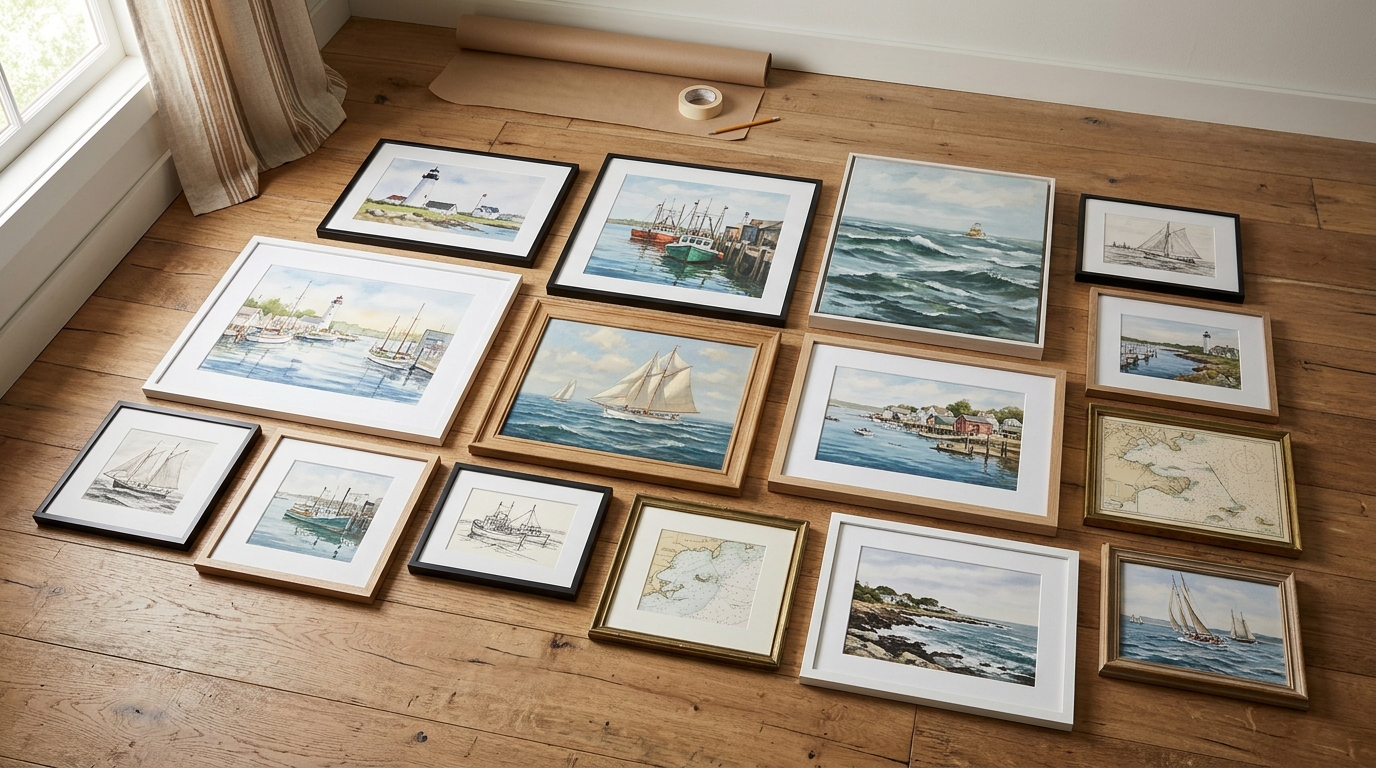
Space individual pieces two to four inches apart to maintain visual connection without crowding, and test the layout on the floor before making the first nail hole. Lay all pieces in your planned arrangement, photograph it from above, then use painter's tape on the wall to mark the corners of each frame. That rehearsal prevents costly errors and lets you adjust spacing before committing.
A cohesive Canadian landscape art wall typically needs five to nine pieces. Fewer risks looking sparse. More risks visual chaos unless the room and wall are very large. The wall size and room scale determine the upper limit. A large living room wall above a sofa can carry seven to nine pieces if they're well spaced. A narrow hallway wall works better with three to five.
Lighting should come from above or the side to highlight coastal textures and maritime hues without glare on the canvas surface. Picture lights or track lighting angled from 30 degrees above the wall bring out the dimension in each brushstroke without creating hot spots.
Avoid These Common Gallery Wall Mistakes
The biggest mistake is treating a gallery wall as permanent wallpaper. It should evolve as you find new pieces that deepen the story. Don't force a piece onto the wall simply because you own it or because it fills a gap; every work must contribute to the coastal narrative.
Avoid mixing too many themes: a wall that includes tropical beaches, mountain peaks and harbour scenes loses its emotional coherence. Stick to one region, one feeling or one palette so the wall reads as a collection rather than a collage. If you love both harbour scenes and forest trails, build two separate walls in different rooms rather than combining them.
Hanging works too high is common. If the bottom edge of the lowest piece is above shoulder height, the entire arrangement feels disconnected from the room. The wall should invite you in, not hover over your head. Walk past the wall at a normal pace and notice where your eyes land naturally. That sightline is where the visual centre belongs.
Know when to stop: a gallery wall is not a collage competition, and white space around the edges gives the eye room to rest. If adding one more piece makes the wall feel crowded rather than complete, step back and call it finished. The most successful walls show restraint. White space functions as visual breathing room that lets each piece contribute to the story without competing for attention.
Build Your Maritime Collection Over Time
A gallery wall doesn't need to be completed in one purchase. The most meaningful collections grow piece by piece as you discover works that resonate. Start with one or two anchor pieces, live with them for a few weeks, then add supporting works that extend the story.
That approach lets you test the visual weight and spacing before committing to the full layout. You might discover that the original painting you chose as your anchor works better slightly left of centre, or that a gap you thought needed filling actually provides helpful breathing room between two larger pieces.
Maritime Seascapes offers works that share a consistent coastal vocabulary, making it easier to build a cohesive wall over months or years. Each piece comes from the same palette of remembered harbours, calm waters and quiet fishing villages painted in Gibsons on the Sunshine Coast. Adding to the collection feels natural rather than forced because the works share a visual language rooted in Canadian landscape tradition and the artist's calm coastal scenes painted from memory.
Every limited-edition canvas print includes a Certificate of Authenticity signed by the artist, documenting the edition size and verifying that the work will never be reprinted beyond the stated number. This transforms each print from decor into a collectible with long-term sentimental and archival value.
Your gallery wall becomes a visual record of your connection to the coast, Canadian landscape tradition and the quiet moments that ground a home. It reflects not just what you hang, but what those images mean to you and the story they tell together.
Frequently asked questions
How do you arrange art on a gallery wall?
Lay all pieces on the floor in your planned arrangement, photograph it, then transfer the layout to the wall using painter's tape to mark corners. Hang the largest or most visually important piece first, then build outward, maintaining two to four inches of space between frames. This rehearsal prevents costly nail holes in the wrong places.
Should gallery wall art be the same size?
No. Mixing sizes creates visual rhythm and prevents a rigid, poster-board look. Pair one large focal piece with medium and small supporting works for a more dynamic and organic arrangement. Uniform sizing can work in a formal grid, but coastal gallery walls feel more natural with varied dimensions that echo the organic shapes of harbours and coastlines.
How do you pick a theme for a gallery wall?
Choose a theme that reflects a personal connection: coastal memories, harbour scenes, a specific region or a feeling you want the room to hold. The Group of Seven heritage offers a strong thematic foundation for Canadian landscape and maritime subject matter. Ask yourself what the wall should remind you of, and let that guide your choices rather than browsing by colour alone.
Can I mix original paintings with limited-edition prints in one gallery?
Yes. Anchor the wall with one original painting as the centre piece, then surround it with coordinating limited-edition prints and art cards. This approach builds a professional collection over time without requiring the budget for multiple originals. The original holds the emotional centre, and the prints extend the narrative outward.
What is the best height to hang a maritime-themed gallery wall?
Hang the visual centre of the arrangement at 57 to 60 inches from the floor, which aligns with comfortable standing eye level. If the wall is viewed primarily from a seated position, lower the centre point by three to six inches. The arrangement should feel connected to your natural sightline, not floating above it.
How many pieces do I need for a cohesive coastal gallery wall?
Five to nine pieces typically create a balanced arrangement. Fewer risks looking sparse, more risks visual clutter. The wall size and room scale determine the upper limit; a large living room wall can carry more pieces than a narrow hallway. Test your layout on the floor before committing to see whether the spacing feels generous or crowded.
Should I use the same frame for every piece in the collection?
Frame consistency matters more than identical frames. Choose a unified palette of wood tones or neutral colours. Avoid mixing ornate gold, rustic barn wood and sleek black frames on the same wall; the art should be the focal point, not competing frame styles. Light natural wood or soft grey frames work across different formats without drawing attention away from the coastal scenes themselves.
